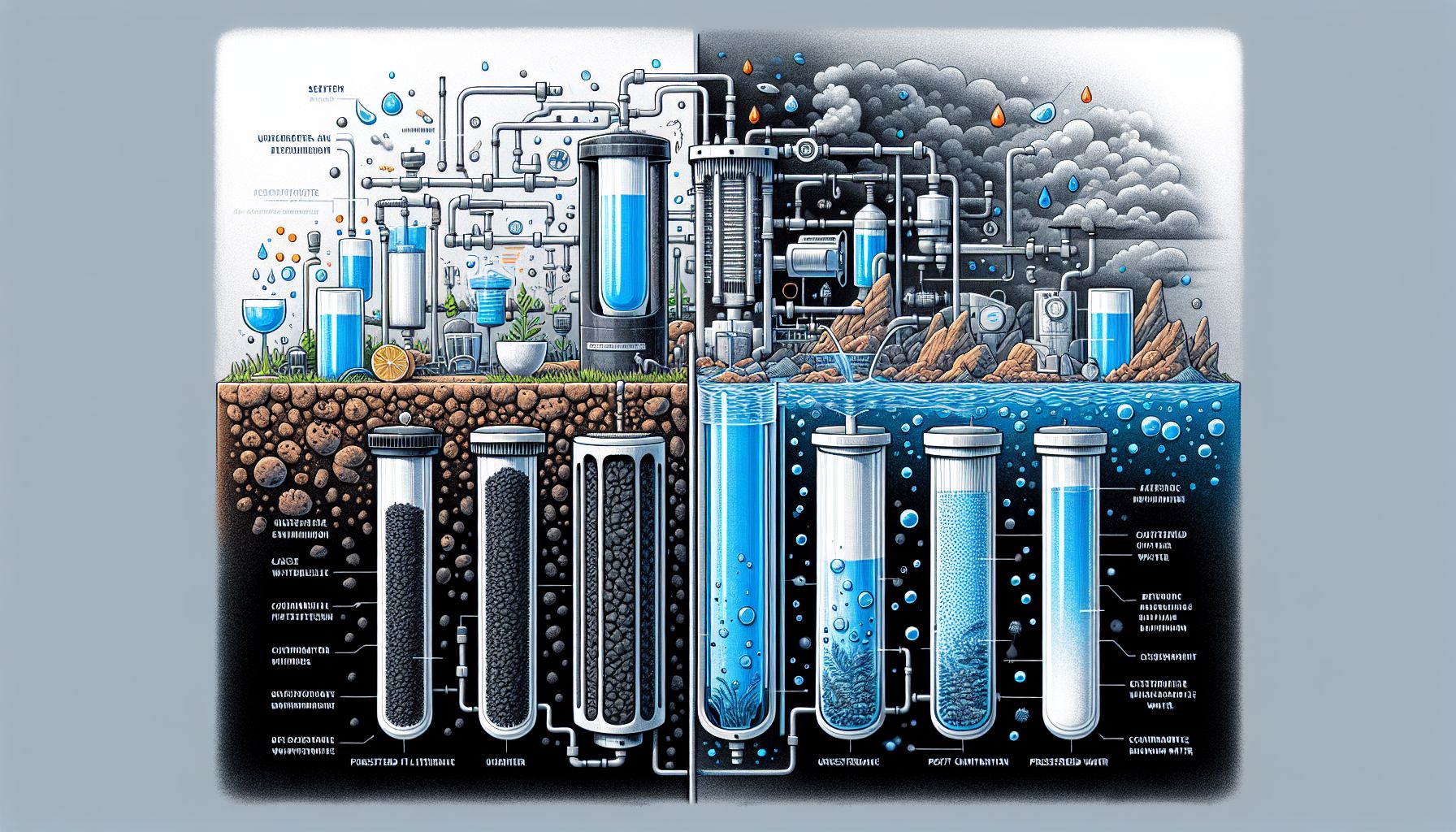
Water is the elixir of life, and ensuring its safety is quintessential to sustain life on earth. From simple cloth filtration used in ancient Egypt to today’s advanced purification technologies, the journey of water purification has been quite progressive. This leads us to an imperative discussion – the comparison of various filtration technologies for safe drinking water.
Filtration Technologies: An Overview
In today’s world, three major filtration technologies have been adopted: mechanical filtration, activated carbon filtration, and reverse osmosis.
Mechanical Filtration
At its core, mechanical filtration functions by blocking particles of a certain size. It employs a semi-permeable material that allows only water molecules to pass, blocking contaminants like sediment, algae, and bacteria.
Fine sand is a common filter medium due to its porosity and size. You might wonder, how effective is it? Well, a top-notch mechanical filter can remove particles down to 0.2 microns, which is smaller than most bacteria *.
Activated Carbon Filtration
Activated carbon, also known as activated charcoal, is a powerful absorbent. It has a large internal surface area that attracts organic compounds and chlorine. Unwanted chemicals stick to the carbon, hence the term ‘adsorption’.
Can activated carbon filters remove all contaminants? Unfortunately, no. They are ineffective against hard water minerals, salts, and microbial contaminants.
Reverse Osmosis
Reverse osmosis (RO) is considered the gold standard in water filtration technologies. It functions by forcing water under pressure through a semi-permeable membrane, much like mechanical filtration. However, the distinguishing point lies in its capability to remove minute contaminants, including salts, hardness ions, and most organic compounds.
How pure is RO water? As per the World Health Organisation, ‘Correctly maintained RO systems can remove 95%–99% of tap water impurities’ *. Their effectiveness places RO systems at the top of our list.
However, an important consideration when implementing any of these three filtration systems is the pre-condition of the water, as proposed by the Oregon State Water Quality. If the incoming water is loaded with particulates or high levels of certain chemical pollutants, even the best filtration system may struggle to deliver an optimal performance. Periodic water quality assessment is crucial to ensure the efficiency of your filtration system Oregon State water quality.
Performance and Sustainability: A Balancing Act
The filtration performance is not the only criterion to consider when selecting a filtration system. Considering the environmental impact and sustainability of the system in terms of wastage and energy consumption is equally critical.
RO filtration, being the most effective, also produces the highest amount of waste water—up to 4 gallons for every gallon filtered, making it less sustainable and increases its ecological footprint. Activated carbon filters, while having the least wastage, tend to saturate quickly and need regular replacement.
Cost-benefit Analysis: The Fiscal Implication
Another critical decision-making factor is the cost—installation, maintenance, and operational costs. The upfront cost of an RO system is high, as are the combatant tasks like frequent membrane replacement and disinfection procedures. This is where mechanical and activated carbon filters take the upper hand. They offer low startup and maintenance costs, making them more economical based on initial outlay.
To conclude, the decision to choose a filtration system for safe drinking water is not straightforward. It involves a multitude of factors – from technology, effectiveness, sustainability, costs, to the quality of the local water. No one size fits all. So, doesn’t it make sense to make informed choices based on systemic comparisons?